
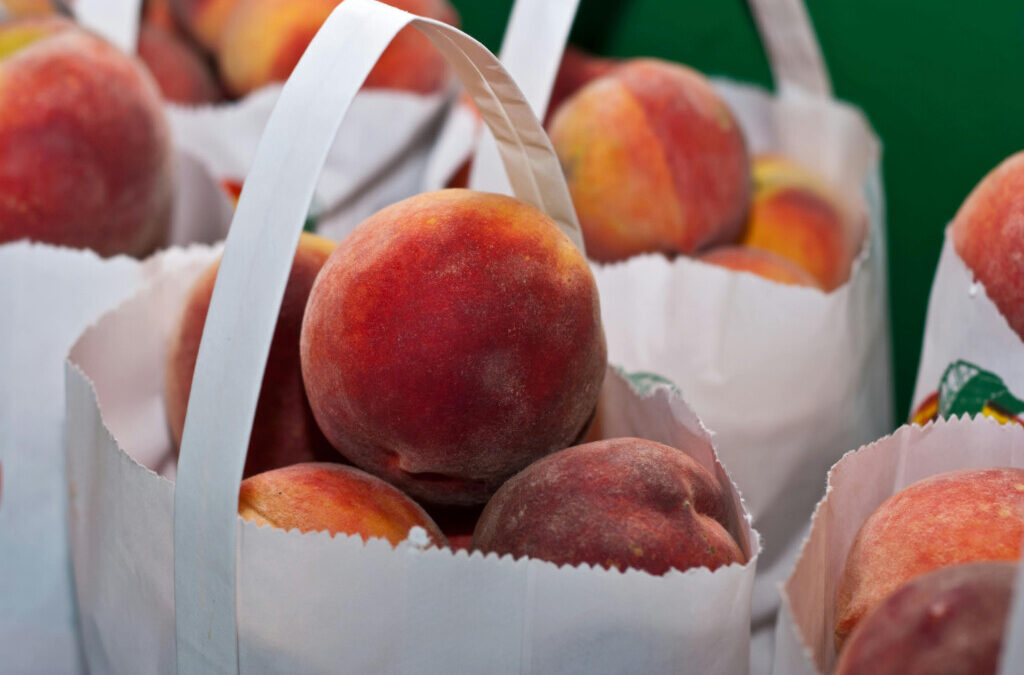
It’s a sort of frenzy here along the Front Range. Peach season.
These aren’t just any peaches. Southwest of here, mountains alternate with red, flat-topped mesas and moon-like deserts. Out there in Palisade, they grow The Peaches.
You may think you have had peaches. But until you have hung over your kitchen sink like a wild creature and slurped the juice of a Palisade peach, unpeeled so as not to waste even one tiny taste, you haven’t really had a peach. Saying you have had peaches and meaning ordinary peaches is like saying you’ve seen heaven when what you mean is that you’ve been to the Sistine Chapel. Michelangelo’s masterpiece is very nice. Worth taking a peek at, for sure. But it’s a far cry from the real thing.
To get the real thing, you have to go to the farmer’s market.
Toward the beginning of August, when even the people who like summer are beginning to feel sticky, overtired, and ready for the thermometer to stop flirting with the triple digits and for everyone to go back to school, the farmer’s market reaches its peak. So, you may think to yourself, “I will make the most of it. I will put on a sundress, grab my most intellectual tote bag, and I will go be provincial.”
And seven or so blocks from the market itself you will realize your mistake.
It’s only nine o’clock in the morning, and the narrow residential side streets are packed tight with parallel-parked cars. Most of the cars are Subarus, well-bumper-stickered. You are outclassed. You are already too late. But you’ve come this far. So you step blinking out into the sun, shoulder your tote bag, and stride with a growing crowd toward the market.
You see people going the other way, parents juggling produce, to-go cups of lemonade, and children in strollers; women with flowers wrapped in brown paper and tote bags even more intellectual than yours; and then somebody with a crate. From across the blisteringly bright crosswalk, you can see that their fingers are white from gripping the heavy box.
“Palisade,” the side of the box reads in arching, old-fashioned letters.
And now you are thinking of peaches and the taste of late-summer sunshine and Saturdays.
You hurry across the street and make a bee-line for a swarm of people enveloping a white tent. You squirm as politely as you can up to a folding table where paper bags hold four sunset-hued spheres.
In Sharpie on index cards, the price: “$16/Basket.”
Sixteen dollars!
Four bucks per peach!
It’s fruit. It literally grows on trees. Is there some sort of fruit shortage caused by the ruthless destruction of market stalls in every summer action blockbuster?
But because you’ve walked practically from the next zip code, or because you can already taste the nectary flavor, or because you made eye contact with the smug, cut-off-wearing farmer and now cannot leave without buying something, you buy the peaches.
As you consider the peaches, you can’t help but wonder if the ones sold earlier in the morning were better. You carefully pick a bag, gripping the paper handle in a sweaty hand, all the way back to your car.
Now what are you going to do with exactly four peaches? Fist-fulls of gold (in more ways than one).
When you get home, if one of them is ripe—velvet skin depressing easily under your thumb—you’ll eat it then and there, in your kitchen, in the gloriously savage manner previously described.
You will lick your lips, sweetness by a faint aftertaste of salt.
Now, what do you do with three perfect peaches?
Baking seems like blasphemy. As if the naked fruit had any shame that needed covering or dressing up.
But slicing them up into cereal, salad, or ice cream seems very formal. And these dregs-of-summer days are so busy.
In the worst-case scenario, you forget about the peaches or attempt to save them for a plan worthy of them. In both cases, they will brown and mold in your fruit bowl.
Probably, you will scarf down the other three over the sink as if it’s forbidden, like Eve in the Garden. (I have serious doubts about the temptation power of an apple, but a peach…) Except that what you’re doing is not pleasing to the eye, nor is the purchase of the peaches evidence of much wisdom.
So it’s probably alright.
August is a strange season. I feel time dribbling through my fingers and down the drain; the year is more than half gone. I should savor things more. I should do more things. And I am eager to get going, for a crisp breeze to stir up the place, and for arrows of geese to point towards…something. Summer feels syrupy thick and cloying, on the edge of overripe. Even though I am not in school, I am sensitive to the change in rhythm in my community. The orange Spirit Halloween banner bedecks a vacant strip mall. I want change and dread it. Peaches, like August, are half-and-half: half sun-bronzed gold, half autumnal wine-red.
But peaches won’t keep until you have a plan for them. Or until you’ve sufficiently processed the passage of time. They defy aesthetic vision. Optimize, perfect, plan all you like. Peaches don’t care.
So wolf them down over the sink before they go to waste.

Emily Stroble is a writer of bits and pieces and is distractedly pursuing lots of novel ideas and nonfiction projects as inspiration strikes. As an editorial assistant at Zondervan, she helps put the pieces of children’s books and Bibles together. A lover of the ridiculous, inexplicable, and wondrous as well as stories of all kinds, Emily enjoys getting lost in museums, movies old and new, making art, the mountains of Colorado, and the unsalted oceans near Grand Rapids. Her movie reviews also appear in the Mixed Media section of The Banner and her strange little stories of the fantastic are on the Calvin alumni fiction blog Presticogitation. Her big dream is to dig her hands deep into the soil of making children’s books as an editor…and to finally finish her children’s novel.

